
WALDO AND ROTHKO – ON THE SAME WAVELENGTH
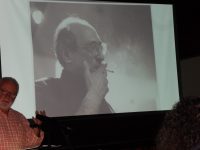
Meirion Jones introduces the American artist, Mark Rothko
Who would have thought it would be possible to draw a comparison between Waldo Williams, the poet, and the artist, Mark Rothko? But that is what Meirion Jones did and that was the gist of his comments as he delivered the Annual Waldo Williams Lecture at Bethel Chapel, Mynachlog-ddu on Friday, 25 September.
One worked with words and the other worked with paint to express much that was similar between them. They shared much of the same values but materialism certainly was not high on their list of values.
Meirion began by relating a story proving Waldo’s wide knowledge and interest in fine art. His father, Aneurin, had an unexpected conversation with Waldo when both held night classes at Ysgol y Preseli when, because of heavy snow, nobody turned up on one occasion.
The horned god
Over a cup of coffee Waldo asked the artist what was his favourite period within fine art. Aneurin responded ‘the Renaissance, of course’. Whereupon Waldo praised the magnificence of Celtic art by referring to the horned god, Cerunnos.
Meirion mentioned another connection between the two, or perhaps the connection that never was, on the occasion of appointing a teacher to the school in Cwm Wysg which Aneurin attended in the early 1950s. A completely non-Welsh speaking teacher was appointed which in the context of the school meant she was completely useless. Who else had applied for the post, as he had just returned from exile in England but Waldo. If only he had been appointed.
But the comparison between Waldo and Rothko. Apparently the American of Lithuanian heritage returned a hefty sum of money he had received on one occasion though he had agreed to provide a series of paintings for a swish new restaurant in one of the New York skyscrapers. He concluded he would be prostituting his talent if he honoured the contract on considering who would be the clientele.
We heard how both would contrast light and dark or two complete opposites. “Chwi blant troednoeth cyfoethog” (You barefoot wealthy children) said Waldo of children he met in Ireland; though they were poor by sight they were also spectacularly wealthy because they spoke Gaelic.
The force of light
To Waldo light expressed his spiritual experience and to Rosko there was strength in light as well. He would mention the inner light within his work and both wished for light within the deepest recesses of their hearts. Both believed the mystery of love would always oust the mystery of hatred.
The lecturer mentioned the nature of eternity as not being a long period of time but some sort of beauty that suddenly touches someone and hence will remain with us. He insisted Jimmy Hendrix was familiar with such beauty as was Waldo, because, even if in the company of others, he would suddenly disappear elsewhere in pursuit of ‘the great thoughts’, as Jac Beynon would testify, when he would enjoy the camaraderie of gathering hay but then would be off walking around the field on his own.
A reference was made to the poem ‘Menywod’ (Women) as proof of Waldo’s knowledge and appreciation of art and that its various versions spoke to each other. Well, he insisted that an artist of the Italian tradition should paint Phebi’r Ddôl and her shawl; a Greek sculptor should produce a bust of Bet Glanrhyd and a dramatist of the ilk of Shakespeare should write a play about Sali’r Crydd. The ordinary rural folk deserved to be immortalised by artists eminent within their fields. It was an enriching lecture.
Listen to the lecture here

Ann Davies reads one of Waldo’s poems
The following morning the Annual Menter Iaith Sir Benfro walk from Bethel Vestry to Carreg Waldo and back, for some refreshments, was held. Meirion described the spot as a sanctuary where he often treads to recharge the soul. There is no castle or mansion nor any symbol representing the authority of this world. He insisted there was a civilized distance between the scattered homesteads but again close enough for the inhabitants to call on each other when in need. A few of Waldo’s poems were read on the spot.